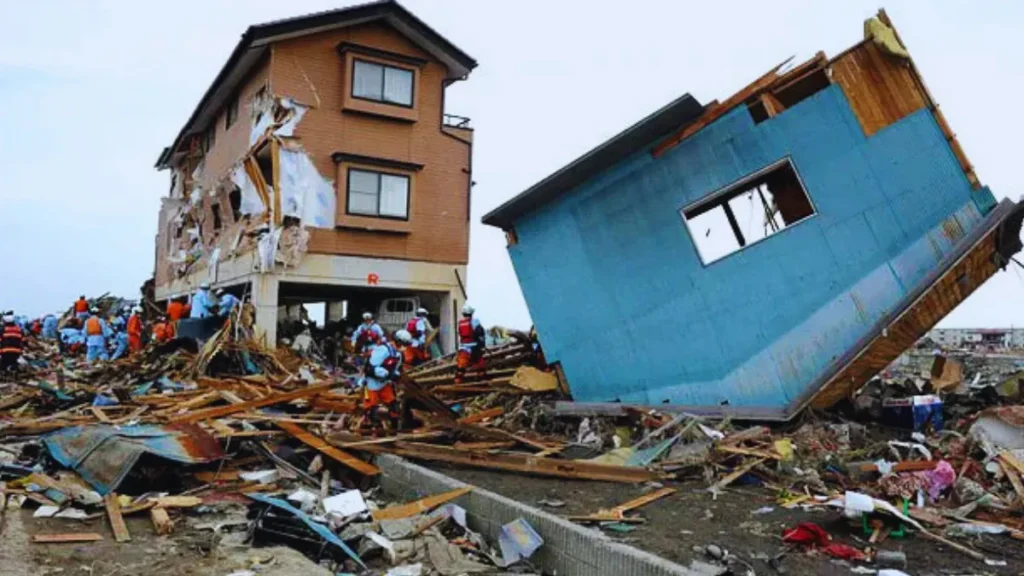
Japan Earthquake: Japan once again faced a powerful seismic jolt this week, reminding the world why the island nation is known as the epicenter of global earthquake activity. Following the latest Japan Earthquake, the country’s Meteorological Agency issued an immediate tsunami alert, warning coastal communities that incoming waves could rise as high as 10 feet. Sirens sounded across multiple prefectures, emergency instructions were broadcast nationwide, and residents were urged to move to higher ground without delay.
According to the Japan Meteorological Agency, the tremor-recorded at a magnitude of 7.6-struck the northern coastline on Monday afternoon, triggering widespread concern along the Pacific rim. The shockwaves were strong enough to be felt across vast regions, prompting rapid evacuation measures in several northeastern coastal towns. As authorities assessed the potential severity of the tsunami, Japan’s sophisticated disaster-response network sprang into action with remarkable speed.
But for a country that experiences more earthquakes than any other nation on Earth, the response was not panic-driven-it was highly organized, polished through decades of preparation, and built on world-leading scientific advancements.

A Nation at the Centre of the “Ring of Fire”
Japan sits atop the notorious Pacific “Ring of Fire,” a 40,000-kilometre arc encircling the Pacific Ocean where several tectonic plates collide, slide, and shift constantly. This region is responsible for roughly 90% of all global earthquakes and a significant percentage of volcanic eruptions. Because Japan lies at the intersection of major tectonic plates-including the Pacific, Eurasian, Philippine Sea, and North American plates-it endures an extraordinary amount of seismic activity.
Data from the Japan Meteorological Agency shows that the country experiences between 1,500 and 2,000 earthquakes every year that are strong enough to be felt by people. While the majority of these quakes fall within low to moderate intensity levels (3–5 on the seismic scale), Japan still records several moderate earthquakes annually and occasionally faces large, destructive events of magnitude 7 or higher.
Yet despite this constant threat, Japan remains one of the safest and most resilient nations in the world when it comes to dealing with natural disasters. Its survival success is not based on luck but on decades of scientific innovation, strict safety policies, and a deeply ingrained culture of preparedness.
World-Leading Earthquake Early Warning System
One of Japan’s most remarkable achievements is its advanced Earthquake Early Warning (EEW) system-considered the fastest and most reliable anywhere in the world. Operated by the Japan Meteorological Agency, the system detects the initial seismic waves that occur before major shaking begins. Within seconds, it sends alerts to televisions, mobile phones, public screens, radio stations, and even factory systems.
This warning window may be only a few seconds long, but those seconds can mean the difference between life and death. Individuals can immediately take cover, schools and workplaces can activate safety protocols, and transportation networks can switch to emergency mode.
Trains across the country-including the iconic Shinkansen bullet trains-are equipped with automated braking systems that activate the moment seismic waves are detected. Elevators automatically stop at the nearest floor to prevent passengers from being trapped. Industrial machinery powers down to avoid damage or accidents. Even hospitals and emergency services receive instant notifications that allow them to mobilize ahead of the strongest shaking.
Japan’s early-warning network also includes extensive ocean-based sensors that monitor seabed movement. These sensors relay real-time data to evaluate the risk of a tsunami moments after a major Japan Earthquake occurs.
A Comprehensive Tsunami Defense Network
Given Japan’s geographical vulnerability, the country has invested heavily in tsunami research and coastal defense structures. After underwater earthquakes, ocean-floor sensors transmit data to the Meteorological Agency, which calculates not only the likelihood of a tsunami but also estimates the height and arrival time of the waves.
Once an alert is activated, coastal communities receive instructions via loudspeakers, radio broadcasts, alarm sirens, and mobile notifications. Evacuations begin almost instantly, and emergency shelters open to accommodate residents who need safety.
In many coastal regions, Japan has constructed massive concrete sea walls, often ranging from 10 to 15 meters in height. While these walls cannot completely eliminate tsunami threats-especially during record-setting disasters-they significantly reduce the impact of medium-sized waves and give communities precious time to escape.
Japan’s approach combines physical protection with highly trained human response systems. Local authorities and emergency volunteers conduct regular evacuation drills, ensuring that residents understand exactly how to react when a warning is issued.
Strict Building Standards: Earthquake-Resistant Architecture
One of the biggest reasons Japan continues to endure frequent seismic activity with relatively limited casualties is its rigorous construction standards. Over several decades, Japan has developed some of the most advanced earthquake-resistant building techniques in the world.
New buildings are designed to absorb shock rather than resist it. Architects use flexible materials, structural dampers, and base isolation mechanisms that allow buildings to sway instead of crumble. Many structures-even tall skyscrapers-are engineered to survive earthquakes with a magnitude of up to 7 or 8.
Older buildings are frequently retrofitted with modern reinforcement systems to protect them from collapse during a Japan Earthquake. Japan’s road networks, bridges, tunnels, and railway systems are also constructed with seismic resilience in mind.
A notable example of the strength of Japanese engineering occurred during the 2011 Tōhoku earthquake, one of the strongest quakes ever recorded. Several skyscrapers in Tokyo, hundreds of kilometers away from the epicenter, swayed dramatically but remained fully intact-a testament to decades of innovation in seismic design.
A Culture of Preparedness: Drills, Education, and Emergency Kits
Preparedness is not just a policy in Japan-it is a way of life. Schools, offices, hospitals, residential buildings, and community centers regularly conduct earthquake and tsunami drills. Every year, on September 1st-Disaster Prevention Day-Japan holds a nationwide training exercise involving millions of participants. This day commemorates the devastating 1923 Great Kanto Earthquake and reinforces the nation’s commitment to readiness.
From a young age, Japanese students learn safety techniques such as “Drop, Cover, and Hold,” ensuring that they know exactly how to react when an earthquake strikes. Public awareness campaigns explain evacuation routes, shelter locations, and emergency procedures.
Most Japanese households maintain a disaster survival kit, which typically includes bottled water, non-perishable food, flashlights, batteries, medicines, documents, and protective gear. This culture of preparedness makes communities more resilient and reduces panic during emergencies.
Heavy Investment in Scientific Research
Japan dedicates significant resources to studying seismic activity. Research agencies, universities, and government institutions collaborate to analyze tectonic movements, model future earthquake scenarios, and develop predictive technologies.
Supercomputers simulate the potential impact of major quakes and tsunamis, helping authorities plan effective evacuation and rescue strategies. Satellite systems, GPS technology, and deep-ocean monitoring equipment provide continuous updates on ground deformation and ocean levels.
This commitment to scientific progress ensures that Japan stays ahead of emerging risks and constantly improves its emergency response systems.
Swift Rescue and Recovery Operations
When a major Japan Earthquake occurs, the country’s emergency response units mobilize within minutes. Japan maintains specialized disaster-management teams at both local and national levels. These teams coordinate food distribution, set up temporary shelters, restore essential services, and search for survivors.
The Japan Self-Defense Forces (JSDF) frequently join rescue efforts, deploying helicopters, ships, and ground units to affected regions. Medical teams, firefighters, and trained volunteers also participate in large-scale emergency responses.
One of Japan’s strengths is its speed in restoring infrastructure. Roads, bridges, power networks, and communication lines are often repaired far more rapidly than in most nations, helping communities return to normal life after disaster strikes.
Conclusion: A Nation That Turns Danger Into Strength
The most recent Japan Earthquake serves as a stark reminder of the geological forces shaping the country. Yet it also highlights the remarkable resilience of a nation that faces thousands of earthquakes each year.
Through cutting-edge technology, robust infrastructure, a culture of preparedness, and scientific dedication, Japan has transformed its vulnerability into a global model of disaster management. While the threat of powerful earthquakes will always loom large over the archipelago, Japan’s commitment to safety ensures that its people remain among the best protected in the world.
If any updates emerge from the latest Japan Earthquake or if you need this rewritten for a different style, location, or publication format, feel free to share more details.