Pakistan Afghanistan War: The already fragile relations between Pakistan and Afghanistan spiralled once again on Friday night, as heavy cross-border firing broke out on the Chaman–Spin Boldak frontier barely two days after both nations concluded another round of unsuccessful peace negotiations. The latest escalation has intensified fears that the region could slide closer to a full-scale confrontation, further fuelling concerns about the possibility of a broader Pakistan Afghanistan war.
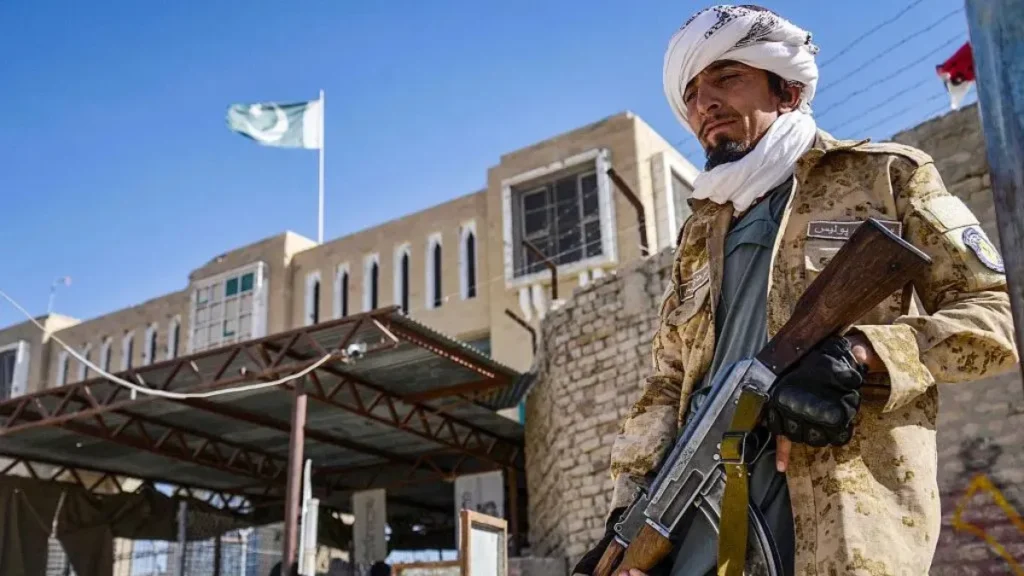
According to officials and eyewitness accounts, the exchange of fire began around 10 p.m. local time and continued late into the night, sending civilians on both sides scrambling for safety. The border crossing, one of the busiest and most sensitive points along the Durand Line, has frequently witnessed confrontations, but Friday’s incident came at a particularly volatile moment when diplomatic engagement was expected to slow down hostilities rather than trigger another clash.
Each Side Blames the Other for Starting the Firing
In the immediate aftermath, both nations released contradicting statements, accusing each other of launching the first attack.
Afghan Taliban spokesperson Zabiullah Mujahid claimed that Pakistan initiated the firing in the Spin Boldak district of Kandahar province. According to him, Pakistani forces opened fire without warning, prompting Afghan border units to launch what he described as a “necessary and measured response.”
“We will not tolerate unprovoked aggression,” Mujahid said, asserting that Afghan forces were compelled to defend their territory. He further blamed Pakistan for destabilising the border region and undermining the peace efforts that both sides had publicly committed to earlier this week.
Pakistan, however, rejected the Taliban’s accusations and presented a sharply different version of events. Senior Pakistani officials stated that it was the Afghan side that carried out the initial attack along the Chaman border without any provocation. In response, Pakistani border troops “acted swiftly and decisively” to neutralise the threat, officials said.
Musharraf Zaidi, spokesperson for the Pakistani Prime Minister’s Office, issued a strongly worded statement declaring, “Pakistan is fully alert and prepared to defend its borders and protect its people. Any violation of our territorial integrity will be dealt with firmly.”
Despite the intense exchange, initial reports indicated no casualties. However, security analysts warned that the absence of immediate fatalities does not reduce the seriousness of the situation, especially given how quickly tensions have escalated in recent months.
Border Clash Comes Only 48 Hours After Peace Talks in Saudi Arabia
What makes the latest clash particularly alarming is its timing. Only 48 hours earlier, delegations from Pakistan and Afghanistan had concluded the third round of peace talks in Saudi Arabia. Held from 2–4 December, the discussions were aimed at reducing border violence, improving trade flows, and addressing Pakistan’s long-standing concerns about terrorist infiltration allegedly carried out from Afghan soil.
However, the meetings ended without any breakthrough. Both sides reiterated their commitment to maintaining a ceasefire, yet neither addressed the root causes of the recurring tensions.
On 4 December, the delegations returned to their respective capitals. Within less than 24 hours, firing broke out again-an outcome that many diplomats saw as a stark indication of the widening trust deficit between Islamabad and Kabul.
Previous rounds of dialogue hosted in Qatar and Turkey also failed to yield any significant progress. No date has been set for the fourth round of talks, leaving the future of diplomacy uncertain as border tensions grow.
Pakistan’s Accusations: Cross-Border Militant Attacks from Afghan Soil
A major factor contributing to the current strain is Pakistan’s repeated allegation that Afghan soil is being used to stage attacks against Pakistani security forces. Islamabad maintains that several militant outfits-particularly the Tehrik-e-Taliban Pakistan (TTP)-continue to operate from sanctuaries in Afghanistan.
According to Pakistani intelligence agencies, dozens of attacks carried out in Balochistan and Khyber Pakhtunkhwa in recent months were planned across the border. Pakistan insists that the Taliban government has not taken sufficient action against these groups despite promises to prevent Afghan territory from being used against neighbouring countries.
The Taliban leadership, however, has consistently rejected Pakistan’s accusations. They argue that Islamabad is attempting to shift blame for its internal security failings onto Afghanistan.
“The Taliban government is committed to maintaining peaceful relations,” spokesperson Mujahid recently stated. “But Pakistan must look inward instead of accusing Afghanistan for every security challenge.”
The opposing narratives underscore the deepening mistrust between the two countries and highlight the fragility of their already strained cooperation.
Chaman–Spin Boldak Border Shut Down Amid Heavy Troop Deployment
The Chaman–Spin Boldak crossing has now been fully shut down following the latest exchange of fire. Long queues of trucks, travellers, and traders have formed on both sides, disrupting one of the most significant economic arteries linking the two nations.
Security sources confirmed that both Pakistan and Afghanistan have deployed additional troops, armoured vehicles, and heavy weaponry to the region in anticipation of further escalation. Residents reported seeing military reinforcements arriving throughout the night.
Several humanitarian groups have expressed concerns that prolonged closure of the border could lead to shortages of essential goods in local markets, affecting thousands of families who rely on cross-border movement for work, medical assistance, and trade.
Analysts warn that the sudden buildup of troops could easily spark more violence, potentially dragging both nations closer to a broader Pakistan Afghanistan war if diplomacy fails.
Pakistan Conducted 3 Midnight Airstrikes Inside Afghanistan on 24 November
The current hostilities cannot be viewed in isolation. Just days earlier, on 24 November, Pakistan carried out three airstrikes inside Afghanistan, targeting the provinces of Khost, Kunar, and Paktika. According to Afghan officials, the strike in Khost resulted in the deaths of ten civilians, including nine children and one woman.
Zabiullah Mujahid condemned the airstrikes as a “violation of Afghan sovereignty” and “an unforgivable act of aggression.” He stated that Pakistani aircraft dropped bombs on a home in the Mughal Gai area of Khost around midnight, killing five boys, four girls, and an adult woman.
Pakistan, however, maintained that the operation targeted militant hideouts used by anti-Pakistan groups planning cross-border attacks. Pakistani officials argued that the strikes were carried out based on credible intelligence and were aimed at eliminating terrorist threats rather than harming civilians.
This incident dramatically escalated tensions and continues to cast a long shadow over diplomatic engagement. The Taliban government claims it has repeatedly conveyed to Islamabad that such strikes are unacceptable, while Pakistan insists it reserves the right to take action when its security is threatened.
Historical Disputes: The Durand Line Issue Continues to Fuel Hostility
The ongoing friction between Pakistan and Afghanistan is deeply rooted in a long-standing dispute over the Durand Line, the 2,640-km border drawn by British colonial authorities in the 19th century. Afghanistan has never fully recognised the Durand Line as an official international boundary, arguing that it divides traditional Pashtun tribal lands and communities.
For decades, Afghan leaders-from the monarchy to the modern republic and now the Taliban-have resisted acknowledging the border as permanent. Pakistan, on the other hand, insists the line is internationally recognised and non-negotiable.
Since the Taliban seized control of Afghanistan in 2021, the dispute has flared up repeatedly. Taliban forces have often attempted to dismantle or obstruct fencing installed by Pakistan along the border, claiming it illegitimately restricts their territory. Pakistani border forces have responded by rebuilding the barriers and attempting to enforce stricter control, resulting in regular clashes.
The unresolved status of the Durand Line remains a major trigger for skirmishes such as the one witnessed this week and continues to fuel narratives of a potential Pakistan Afghanistan war.
Escalating Tensions, Rising Hostilities, and the Growing Risk of a Wider Conflict
Security experts across South Asia warn that the border confrontations are becoming increasingly frequent and intense, raising fears of a larger conflict if diplomatic channels collapse. Analysts say the combination of militant activity, mistrust between the two governments, and a historically disputed border makes the region highly combustible.
Key Factors Driving Current Unrest
- Pakistan’s frustration over TTP sanctuaries in Afghanistan
Islamabad believes the Taliban leadership is either unwilling or unable to curtail the activities of anti-Pakistan militants. - Afghanistan’s resentment over cross-border strikes and heavy fencing
Many in Afghanistan view Pakistani military actions as violations of sovereignty. - Economic pressures and border closures
Regular shutdowns of crossings like Chaman severely disrupt livelihoods on both sides. - Lack of sustained diplomatic progress
Talks in Qatar, Turkey, and Saudi Arabia have repeatedly failed to produce meaningful results. - Deep historical disputes, especially over the Durand Line
This century-old issue remains unresolved and emotionally charged.
Given these realities, many observers fear that any minor incident could spark a chain reaction leading to a much larger confrontation-one that global media increasingly refers to as the emerging shadow of a Pakistan Afghanistan war.
What Happens Next? Outlook for Regional Stability
With troop numbers rising, border crossings closed, and diplomatic efforts stalled, the coming days are expected to be critical. Diplomats from neighbouring countries and international organisations are urging both Islamabad and Kabul to resume dialogue before the situation deteriorates further.
Saudi Arabia, Qatar, and Turkey-three nations that have previously hosted talks-may attempt to re-engage both sides, but it is unclear whether either government is currently in a position to make concessions. Domestic political pressures in Pakistan, coupled with the Taliban’s desire to project sovereignty, leave little room for compromise.
Meanwhile, residents near the border brace for uncertainty, fearing that the latest confrontation may only be the beginning of a longer period of instability.
Read also: UAE Not Issuing Visas to Pakistanis: Rising Rejections Spark Major Concerns Among Travelers
Conclusion: A Fragile Peace Under Threat
Friday night’s clash along the Chaman–Spin Boldak border highlights the dangerous volatility characterising Pakistan–Afghanistan relations today. With each side blaming the other for aggression, peace negotiations faltering, and military activity increasing, the risk of a more serious confrontation is growing.
Unless both nations commit to genuine dialogue and concrete steps to address mutual concerns, the region may inch closer to a prolonged conflict-one that could have far-reaching consequences not only for the two countries but for the wider South Asian geopolitical landscape. The spectre of a Pakistan Afghanistan war, once considered unthinkable, now looms as a genuine concern in diplomatic circles.