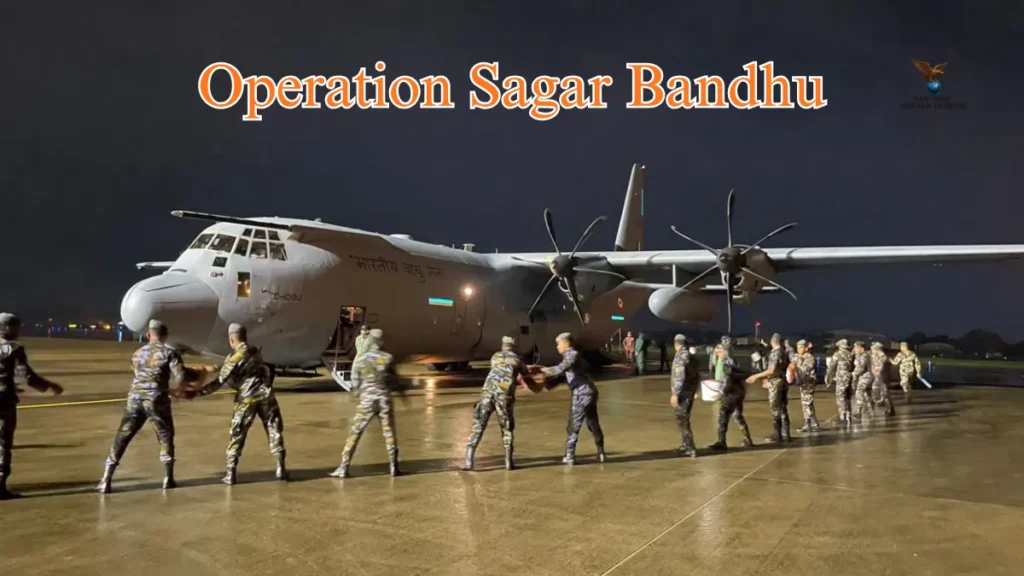
Operation Sagar Bandhu: In a powerful demonstration of regional solidarity and rapid humanitarian support, India has deployed specialised National Disaster Response Force (NDRF) teams and large consignments of relief supplies to Sri Lanka under Operation Sagar Bandhu, following the destruction caused by Cyclone Ditwah. The operation marks one of the most extensive emergency relief missions launched by India in the Indian Ocean region in recent months, reinforcing its commitment to neighbouring nations in the face of natural disasters.
The twin-mission humanitarian effort involves the deployment of elite NDRF rescuers, life-saving equipment, medical supplies, and multiple consignments of relief materials transported by the Indian Air Force (IAF) and the Indian Navy. With Sri Lanka reeling under the impact of Cyclone Ditwah—which has resulted in deaths, displacement, and widespread structural damage—India’s response has been swift, coordinated, and multi-layered.
NDRF Teams Airlifted to Colombo in Early-Morning Operation
India’s first major response unfolded early Saturday morning when two dedicated NDRF teams, comprising 80 highly trained rescuers and four specialised search-and-rescue canines, were airlifted from the Hindon Airbase. The contingent, placed under the leadership of Commandant P.K. Tiwary of the 8th Battalion, departed at 4:06 a.m. aboard an Indian Air Force IL-76 heavy-lift aircraft.
According to an official communication from the NDRF Headquarters, the teams were equipped with an extensive array of high-precision rescue tools—including inflatable rescue crafts, hydraulic cutting systems, advanced breaching tools, satellite-based communication devices, trauma and medical first-aid kits, and other emergency lifesaving gear. The teams are expected to support wide-scale evacuations, assist in search operations, provide medical aid, and help stabilise communities severely affected by the cyclone across Sri Lanka’s coastal districts.
This deployment marks the latest in a series of international missions by the NDRF, which has become one of the world’s most recognised disaster-response agencies, known for its swift, coordinated, and technically advanced rescue operations.
IAF Aircraft Delivers 12 Tonnes of Relief Supplies to Colombo
Simultaneously, humanitarian supplies began reaching Sri Lanka under the broader umbrella of Operation Sagar Bandhu. A separate Indian Air Force C-130 J Super Hercules aircraft landed in Colombo on Saturday carrying approximately 12 tonnes of essential aid. The consignment included:
- Emergency tents
- Waterproof tarpaulins
- Blankets for displaced families
- Comprehensive hygiene kits
- Ready-to-eat food packets
- Other immediate relief materials required for cyclone-hit communities
External Affairs Minister S. Jaishankar confirmed the delivery on X, stating that the relief mission was progressing swiftly and in full alignment with India’s commitment to supporting its neighbours in times of crisis.
The minister’s update, which specifically referred to the rapid unfolding of Operation Sagar Bandhu, emphasised India’s readiness to scale up assistance further if required by Sri Lankan authorities.
Earlier Shipments Delivered by Indian Naval Vessels
India’s maritime assistance to Sri Lanka began even before the airlifted consignments, as part of the same relief initiative. On Friday, Indian Naval Ship (INS) Vikrant and INS Udaygiri delivered urgent Humanitarian Assistance and Disaster Relief (HADR) items to Sri Lanka’s ports. These shipments included:
- 4.5 tonnes of dry rations
- 2 tonnes of fresh provisions
- Multiple containers of essential day-to-day relief supplies
According to the Indian High Commission in Colombo, these deliveries were aimed at supporting thousands of families displaced or affected by Cyclone Ditwah. The High Commission reiterated India’s unwavering support to Sri Lanka, noting that Operation Sagar Bandhu is another testament to the long-standing partnership and India’s “Neighbourhood First” policy.
In its official statement on X, the High Commission highlighted India’s readiness to stand shoulder-to-shoulder with Sri Lanka during challenging times and reaffirmed the intention to continue providing whatever additional support may be needed in the coming days.
Prime Minister Modi Expresses Condolences and Assures Continued Support
Prime Minister Narendra Modi also expressed his condolences to the people of Sri Lanka following the devastating loss of life and widespread impact of Cyclone Ditwah. In a post on X, he offered sympathies to families mourning their loved ones and assured that India had promptly dispatched emergency materials and disaster-relief resources under Operation Sagar Bandhu.
He wrote that India “stands ready to provide more aid and assistance as the situation evolves” and reiterated that the support extended to Sri Lanka is rooted deeply in India’s Neighbourhood First policy and the broader maritime vision of MAHASAGAR, which emphasises regional unity, cooperation, and security in the Indian Ocean.
Modi’s message underscores the significance of this operation not merely as a disaster-relief effort but also as a continuation of India’s longstanding commitment to stability, safety, and humanitarian support across South Asia.
Cyclone Ditwah’s Intensification and Impact Across Sri Lanka and South India
Cyclone Ditwah has continued to intensify over the southwest Bay of Bengal, following a consistent northward movement at approximately eight kilometres per hour over the previous six hours. As of 2:30 a.m. on Saturday, the system was positioned around 430 kilometres south of Chennai, prompting precautionary measures across Tamil Nadu and raising serious concerns over its potential impact.
Heavy rains, strong winds, and coastal flooding in parts of Sri Lanka have resulted in multiple casualties and the displacement of thousands. Local infrastructure—particularly power lines, roads, houses, and coastal facilities—has suffered significant damage. As the storm’s outer bands approached the Indian coastline, Chennai and its neighbouring regions woke up to widespread rainfall accompanied by dark skies and intensifying winds.
In anticipation of potential spillover effects along the Tamil Nadu coastline, Indian authorities activated heightened disaster preparedness protocols.
Domestic Preparedness: NDRF Positions 14 Teams Across Tamil Nadu
While providing substantial support to Sri Lanka, India has also been preparing actively for the cyclone’s possible impact on its own shores. The NDRF has deployed 14 specialised teams across the most vulnerable districts in Tamil Nadu, including:
- Villupuram
- Chengalpattu
- Tiruvallur
- Nagapattinam
- Tiruvarur
- Thanjavur
- Pudukkottai
- Mayiladuthurai
Additional teams have also been dispatched to the Union Territory of Puducherry. Meanwhile, 10 more NDRF teams are currently en route to Chennai from Pune and Vadodara, adding to the layered preparedness strategy designed to address the cyclone’s evolving trajectory.
These teams are equipped with all necessary gear for flood-related rescues, water evacuation, medical assistance, and restoring critical connectivity in case of infrastructural breakdowns.
Round-the-Clock Monitoring and Multi-Agency Coordination
The NDRF has confirmed that it is engaged in 24×7 monitoring of the situation in continuous coordination with:
- India Meteorological Department (IMD)
- National Disaster Management Authority (NDMA)
- Ministry of External Affairs (MEA)
- State governments of Tamil Nadu and Puducherry
- Indian Air Force and Indian Navy
- Sri Lankan authorities
The meticulously coordinated structure ensures that resources can be diverted, expanded, or relocated as the cyclone develops. This high level of inter-agency communication has become a hallmark of India’s disaster-response model and is particularly visible in the handling of Operation Sagar Bandhu.
Operation Sagar Bandhu: A Continuing Tradition of Humanitarian Leadership
India’s decision to launch Operation Sagar Bandhu draws from its wider framework of humanitarian maritime missions, including earlier initiatives such as Operation Sagar Aaraksha, Operation Samudra Setu, and various HADR deployments to countries like Maldives, Mozambique, Madagascar, Turkey, and Nepal.
Operation Sagar Bandhu is built upon the principles of:
- Rapid humanitarian response
- Regional solidarity
- Disaster-relief diplomacy
- Efficient coordination between armed forces and civilian agencies
This approach enhances India’s role as a dependable first responder in the Indian Ocean Region (IOR) and reinforces the perception of India as a committed partner in global humanitarian efforts.
Sri Lanka’s Ongoing Challenges After Cyclone Ditwah
As relief operations continue, Sri Lanka faces a series of significant challenges:
- Widespread Infrastructure Damage: Roads, bridges, power lines, and coastal areas have suffered extensive destruction.
- High Displacement Numbers: Thousands of families have been forced to leave their homes due to flooding and structural collapse.
- Shortage of Essential Supplies: Food, clean water, medical aid, and shelter materials are needed urgently across multiple districts.
- Strain on Local Emergency Services: Local authorities have struggled to cope with the scale of the disaster, prompting requests for international assistance.
India’s support under Operation Sagar Bandhu is expected to ease pressure on ground teams and facilitate faster relief distribution.
A Regional Mission with Global Attention
The unfolding of Operation Sagar Bandhu has been closely monitored by global observers, with many highlighting India’s proactive stance in providing immediate relief. As climate-related disasters increase in frequency across South Asia, India’s role in regional disaster response has taken on broader significance—not only politically, but also strategically and humanitarianly.
Cyclone Ditwah has brought renewed attention to the vulnerabilities faced by smaller island nations and coastal regions in the Indian Ocean, underscoring the importance of cross-border cooperation.
Conclusion: India Stands Firmly With Sri Lanka During Its Hour of Need
From airlifting skilled rescue teams to delivering tonnes of relief supplies within hours, India’s execution of Operation Sagar Bandhu reflects a deep-rooted commitment to humanitarian assistance and regional cooperation. As Cyclone Ditwah continues to impact lives across Sri Lanka and the southern coast of India, coordinated rescue, relief, and rehabilitation efforts remain crucial.
India’s rapid mobilisation—through the NDRF, Indian Air Force, Indian Navy, and diplomatic channels—has once again demonstrated the country’s leadership in disaster relief in the Indian Ocean Region. With both nations working closely, the ongoing mission is expected to save lives, provide essential aid, and reaffirm the enduring bonds between India and Sri Lanka in challenging times.