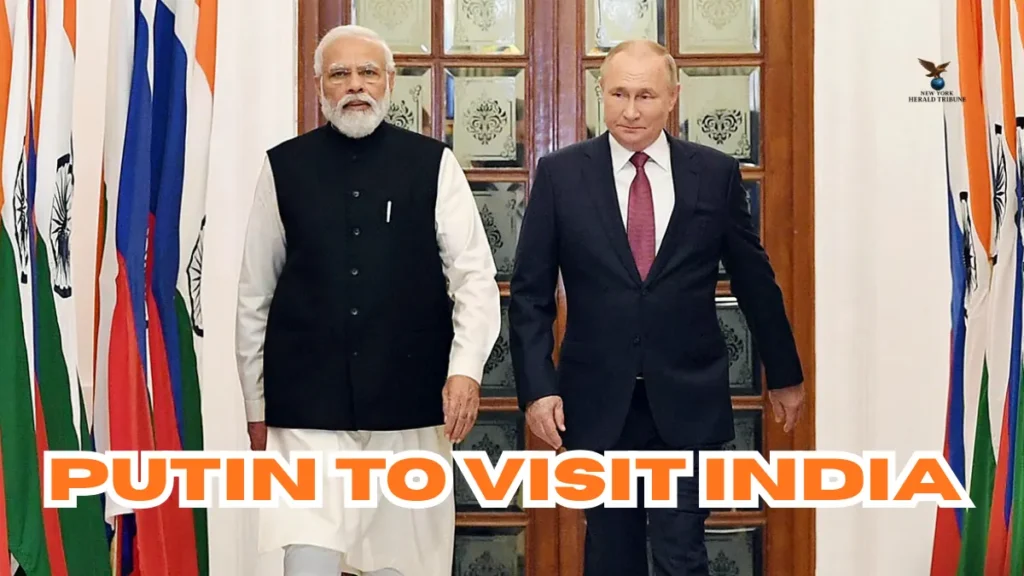
Putin to Visit India: Russian President Vladimir Putin will travel to India on December 4 for a two-day official visit, marking his first trip to the country since the outbreak of the Russia-Ukraine war in 2022. His return to New Delhi comes at a crucial moment in global geopolitics, trade realignments, and defence partnerships, and is expected to reset several dimensions of the India-Russia relationship.
Putin will participate in the 23rd Annual India–Russia Summit, a tradition followed by both nations for more than two decades. India and Russia host this high-level bilateral meeting alternately every year, and 2024 happens to be India’s turn to welcome the Russian leader.
During the summit, Putin is scheduled to hold extensive talks with Prime Minister Narendra Modi, focusing on energy cooperation, defence agreements, strategic trade routes, payment mechanisms, and potential expansions of the Free Trade Agreement (FTA) framework. President Droupadi Murmu will also host a state banquet in honour of the visiting leader.
Oil Trade Under Spotlight After US Tariff Pressure
One of the most critical elements of the upcoming discussions will revolve around India’s continued purchase of discounted Russian crude oil. In the aftermath of the Ukraine conflict, India emerged as Russia’s second-largest oil buyer, taking advantage of reduced rates. However, the United States recently imposed a 25% additional tariff on several Indian exports, effectively bringing the total tariff burden to 50%, citing India’s growing oil imports from Russia.
Washington argues that the revenue generated from these exports indirectly helps Russia sustain its activities in Ukraine.
Indian officials, however, maintain that their energy procurement decisions are driven by national economic priorities and do not violate any global sanctions frameworks that India subscribes to. With Putin to visit India, energy trade-especially crude oil supply security-will be a priority topic.
Defence Cooperation Expected to Dominate the Visit
Defence collaboration has always been the strongest pillar of India–Russia relations, and this visit is likely to reinforce that legacy. Moscow has already indicated its willingness to offer India its SU-57 fifth-generation stealth fighter jets, the most advanced aircraft in Russia’s arsenal.
India has been exploring options to modernise its fighter jet fleet, and the SU-57 offer could significantly shape the future of the Indian Air Force’s long-term modernization plans.
Beyond fighter jets, several other major defence discussions are expected, including:
- Pending deliveries of the S-400 missile defence system
- Possible future cooperation on Russia’s S-500 air defence platform
- Next-generation BrahMos missile development
- Joint manufacturing of naval warships
- Technology transfers for long-term security cooperation
The defence outcomes of this visit may redefine the strategic balance in the region, especially given India’s increasing security needs and Russia’s shift toward Asian markets after Western sanctions.
A New India–Russia Payment System on the Cards
Energy and defence trade between India and Russia has grown, but payment challenges-triggered by Western sanctions—have often disrupted transactions. With Putin to visit India, both sides are expected to negotiate a new, stable payment mechanism that bypasses obstacles created by traditional banking channels.
Options under consideration include:
- A rupee–ruble trade settlement system
- A digital payment platform exclusive to both nations
- The use of a third-country bank for neutral settlement
The goal is to ensure that bilateral trade continues smoothly regardless of geopolitical pressure from the West.
Additionally, Russia is likely to invite India to invest in Arctic energy projects, a region rich in unexplored oil and natural gas reserves. Moscow has been developing large hydrocarbon fields there and sees India as a strategic long-term partner.
Labour Mobility Agreement May Open Doors for Indian Workers
Another key area of discussion is a potential skilled labour cooperation agreement. Since the war, Russia has faced significant labour shortages across multiple sectors-engineering, medical services, construction, energy projects, and IT services. Moscow is reportedly keen on hiring skilled Indian professionals to fill these gaps.
For India, this could create thousands of new overseas employment opportunities, particularly for technical, medical, and engineering talent. If finalized, this agreement could become one of the most impactful outcomes of Putin’s visit.
Cooperation in Space, Nuclear Energy, Science and Port Development
The two nations are also preparing to strengthen partnerships in space exploration, nuclear energy, science and technology, maritime logistics, and port infrastructure.
India’s largest nuclear energy facility—the Kudankulam Nuclear Power Plant in Tamil Nadu—is being developed in collaboration with Russia. The summit may include discussions on advancing subsequent phases of this project.
Space cooperation could also see new proposals as both countries seek to expand their capabilities in satellite systems, lunar missions, and high-precision navigation technologies.
Putin Had Indicated His Visit Three Months Ago
The groundwork for this visit began in August when India’s National Security Adviser Ajit Doval travelled to Moscow and met President Putin at the Kremlin. Their talks focused on security, energy cooperation, and long-term economic engagement.
Doval had stated that India holds its partnership with Russia in “high regard,” describing the relationship as both historic and strategic. Following the meeting, it was informally indicated that Putin to visit India before the end of the year.
Putin’s Last Visit to India Was in 2021
Putin last visited India on December 6, 2021, for a short four-hour trip during which New Delhi and Moscow signed 28 agreements across defence, technology, and cross-sector partnerships.
At that time, both nations also set an ambitious target: reaching $30 billion in annual bilateral trade by 2025.
However, in the last two years, trade volumes have surged far beyond that due to the oil boom. India and Russia now aim to increase bilateral trade to over $100 billion annually, nearly double the current estimated figure of $60 billion.
Prime Minister Modi Visited Russia Twice in 2024
Prime Minister Modi has already visited Russia twice in 2024.
- October 22 – Modi attended the BRICS Summit hosted in Russia.
- July 2024 – Modi undertook a two-day bilateral visit and personally invited Putin to India.
These engagements helped stabilize ties at a time when global strategic blocs are shifting rapidly.
Why Putin Has Avoided Most Foreign Trips Since 2023
In March 2023, the International Criminal Court (ICC) issued an arrest warrant against President Putin over allegations related to the deportation of Ukrainian children during the conflict. These charges prompted Moscow to dismiss the ruling as politically motivated, but the implications have limited Putin’s international travel.
The warrant marked the first time the ICC targeted a sitting leader from a United Nations Security Council (UNSC) permanent member state.
Since then, Putin has minimized overseas trips. He skipped both the 2023 G20 Summit hosted by India and the 2024 G20 Summit in Brazil, sending Foreign Minister Sergei Lavrov as his representative.
Despite this caution, Putin’s decision to visit India underscores the depth of India-Russia ties and signals that New Delhi remains one of Moscow’s most trusted and strategically important partners.
A Historic Visit With Far-Reaching Implications
The forthcoming summit carries enormous significance. With Putin to visit India at a time when global alliances are reshaping, India finds itself balancing ties with the West while maintaining its long-standing strategic partnership with Russia.
Key outcomes likely to emerge from the visit include:
- Major defence procurement announcements
- A long-term oil and energy supply pact
- A breakthrough in international payment systems
- Expansion of nuclear and space collaboration
- Potential employment pathways for Indian professionals in Russia
- Strengthening of trade targets toward $100 billion and beyond
As the world observes this pivotal meeting, the visit could redefine not just bilateral relations but also influence the broader geopolitical calculus across Asia, Europe, and the Global South.