Fire in Hong Kong Apartment: A devastating fire in a Hong Kong apartment complex has raised serious questions about long-standing construction practices, after a massive blaze swept through multiple residential towers in the Tai Po district and killed at least 44 people. The disaster has now triggered a manslaughter investigation into the renovation company responsible for repair work at the buildings.
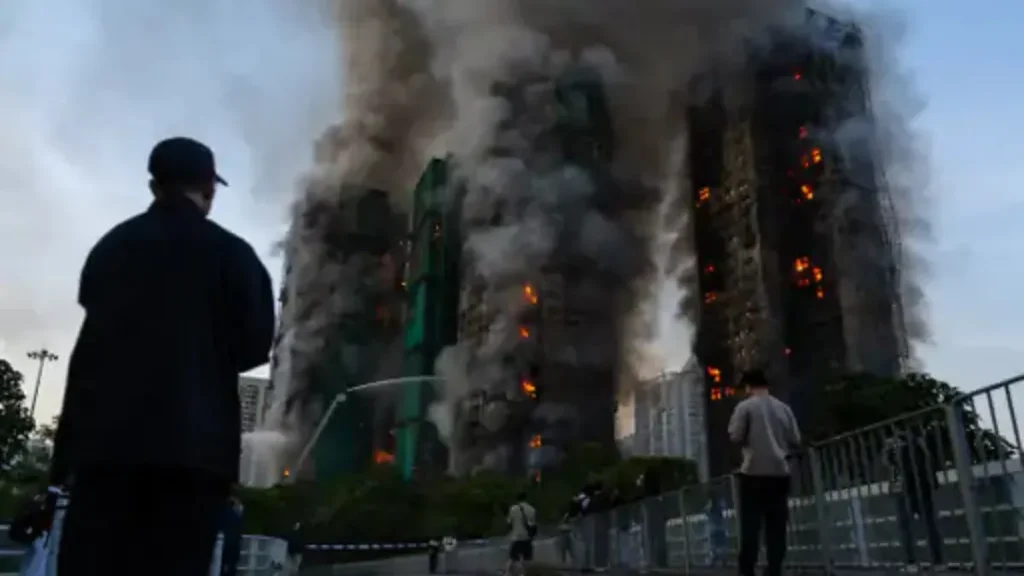
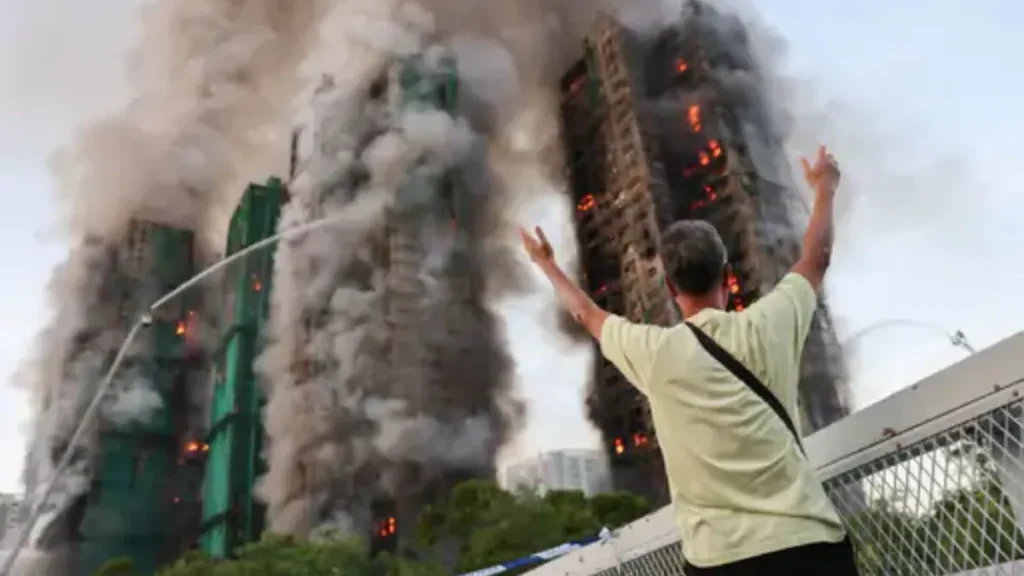
According to authorities, the fire erupted on Wednesday afternoon inside Wang Fuk Court — a crowded housing estate home to thousands of residents. The flames spread so quickly across seven of the estate’s eight towers that emergency responders struggled through the night to reach residents trapped behind walls of heat and smoke.
Officials later confirmed that three executives from a construction firm had been arrested on suspicion of manslaughter, as investigators examine whether illegally installed or unsafe materials intensified the speed and scale of the blaze.
#BreakingBad .
— PoonamSharma (@Poonam_1992) November 27, 2025
44 Dead After Massive Fire Ravages 7 High-Rise Buildings In Hong Kong, 3 Arrested pic.twitter.com/dwn5kf1YWj
How the Fire Spread at Alarming Speed
Fire Services teams reported that the blaze began shortly before 3 p.m. in Wang Cheong House, a 32-storey tower undergoing renovation. The entire building was covered in bamboo scaffolding, a familiar sight in Hong Kong but one that may have contributed to the rapid spread.
Deputy Director of Operations Derek Armstrong Chan said the scaffolding was already burning when firefighters arrived. Within minutes, bamboo poles collapsed and pieces of the burning structure fell across exterior walls, allowing flames to jump quickly to neighbouring towers. Strong winds in the area acted like a fuel source, pushing the fire horizontally across the estate.
Officials said seven towers caught fire, leaving terrified residents to flee down dark, smoke-filled staircases or wait for rescue teams to reach upper floors. Thousands were forced into makeshift shelters as their homes burned.
Discovery of Potentially Illegal Materials
Security Secretary Chris Tang expressed deep concern about the unusual intensity of the fire. Early inspections uncovered several materials that were not only highly flammable but also appeared to violate building-safety regulations.
According to Tang, investigators found:
- Exterior netting that burned far faster than approved types
- Tarpaulin that ignited almost instantly
- Plastic sheeting that created thick, dangerous flames
“These materials allowed the fire to spread at a speed far beyond what we would expect from regulated construction products,” Tang said. “This is highly irregular and demands a full investigation.”
Fire Services Director Andy Yeung confirmed yet another alarming discovery: styrofoam had been applied around window frames during the renovation. According to reports, especially from the South China Morning Post, this styrofoam acted as a conduit for flames, helping fire travel through corridors and reach multiple apartment units at different levels.
Yeung explained that the styrofoam “blocked ventilation gaps and was extremely flammable,” which made the fire far more intense and difficult to control.
In response, police and fire authorities have formed a joint task force to determine if criminal negligence or cost-cutting contributed to the disaster. Hong Kong Chief Executive John Lee said that establishing accountability is now a top priority.
Is Bamboo Scaffolding a Hidden Risk?
The tragedy has reignited debate over one of Hong Kong’s most widespread construction practices: bamboo scaffolding. While admired for its low cost, flexibility, and deep cultural roots, bamboo is inherently combustible — especially when combined with plastic netting and renovation materials that many crews use for weather protection.
Hong Kong is among the last major cities in the world where bamboo scaffolding remains common even on tall residential buildings. Although the government had already begun transitioning toward more steel scaffolding in public projects, the shift has faced strong resistance from labour unions. Nearly 4,000 trained scaffold workers, often known as “spidermen,” depend on bamboo scaffolding for their livelihoods.
This incident could accelerate calls to tighten restrictions or implement stricter safety checks when bamboo structures are used in high-rise renovation zones.
A Massive Firefighting Effort: 888 Responders Deployed
The scale of the emergency response highlights the severity of the situation. Authorities deployed 888 firefighters — an unusually large number — as flames rapidly moved between towers. Crews battled through collapsing scaffolding, falling debris, and suffocating smoke to reach residents stranded in upper-level flats.
With over 4,000 people living in the affected towers, many elderly or with limited mobility, officials believe the final death toll could rise significantly. Several residents remain unaccounted for, and searches are continuing across the damaged buildings.
This disaster is now considered one of the deadliest high-rise fires in Hong Kong since the 1990s. The rapid spread shocked many residents who said they had never witnessed flames travel across multiple towers within minutes.
A City Demanding Answers: Fire in Hong Kong Apartment
As rescue operations continue, grief and anger are rising across the Tai Po community. Survivors have reported harrowing scenes of families trapped behind locked gates, neighbours signaling for help from smoke-filled balconies, and entire hallways turning into tunnels of fire within seconds.
Local support groups have mobilized to provide emergency supplies, while survivors wait for clarity on the fate of their missing loved ones.
The Hong Kong government has vowed full transparency and a comprehensive investigation into the construction practices, renovation oversight, and materials used during the repairs. Officials say the speed and scale of the fire in the Hong Kong apartment complex raises urgent concerns about regulatory compliance and building-safety monitoring.
Many residents say the tragedy could have been avoided altogether.
“This should never have happened,” said one survivor. “Someone needs to be held responsible.”
A Potential Turning Point for Building Regulations
The catastrophe has placed intense pressure on authorities to re-evaluate Hong Kong’s construction standards. Investigators will now examine whether:
- Non-approved materials were used
- Contractors bypassed safety rules to cut costs
- Bamboo scaffolding contributed to the spread
- Safety inspections were properly carried out
- Building codes need urgent revisions
For now, families mourn, survivors search for answers, and the city faces the grim aftermath of one of its most shocking fires in decades. The investigation will determine whether this tragedy becomes a painful lesson — or a catalyst for long-overdue change in Hong Kong’s construction and safety regulations.