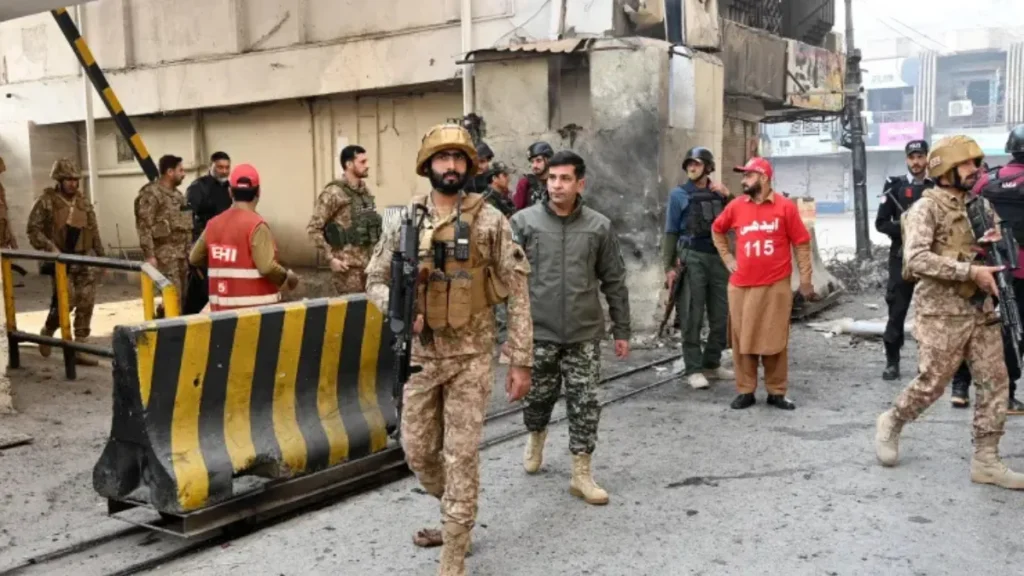
Peshawar, Pakistan–Attack in Pakistan: A major security crisis unfolded on Monday morning as two suicide bombers stormed the Frontier Constabulary (FC) Headquarters in Peshawar, launching a coordinated attack that killed three elite commandos and left multiple others wounded. All three attackers were shot dead during intense gunfire inside the fortified compound. The incident marks one of the most serious militant operations in recent months and has raised new alarms over the growing instability in northwestern Pakistan.
According to military officials, the assault began around 8:00 a.m., when heavily armed militants detonated explosives at the main entrance of the paramilitary facility before forcing their way inside. The blasts shook nearby residential and military zones, triggering immediate counter-operations involving FC commandos, police, and special security units.
Security personnel described the incident as a “well-planned and high-precision suicide mission” intended to inflict maximum damage. “The militants attacked with heavy gunfire followed by suicide explosions to breach our defences,” an official confirmed while speaking to the media near the attack site.
Peshawar FC Chowk Main sadar blast pic.twitter.com/VRxzfZqEbP
— Abbas Kham (@Abbaskh68764192) November 24, 2025
How the Attack Unfolded: Series of Explosions Followed by Fierce Gun Battle
Eyewitnesses reported hearing two massive explosions at the front gate of the FC Headquarters. The blasts were quickly followed by a barrage of gunfire as the attackers entered the compound and engaged security forces in close-range combat.
Officers on duty responded immediately and launched a sweeping counter-assault to block the militants from advancing deeper into the facility. A fierce gun battle continued for several minutes until all three attackers were neutralised.
Multiple videos shared on social media moments after the assault captured gunshots echoing across Peshawar and clouds of smoke rising from the FC offices. The authenticity of the videos has not yet been independently verified, but authorities confirmed that explosions were indeed heard across Saddar, the city’s main commercial zone.
The FC Headquarters is located in a heavily populated area close to key military and administrative installations, which further intensified concerns about the attackers’ ability to penetrate such a high-security zone.
Pakistan Blames the Tehrik-e-Taliban Pakistan (TTP)
Soon after stabilising the situation, Pakistan’s security establishment publicly held the Tehrik-e-Taliban Pakistan (TTP) responsible. In a sharply worded statement, the Pakistan Army accused the militants of operating as “Indian-backed Khawarij radicals,” adding that the incident was orchestrated to destabilise the country’s internal security.
TTP has not issued an official claim at the time of reporting, but the group has carried out numerous similar operations targeting the military, police, and strategic government sites over the past decade. Analysts emphasise that the method of execution — suicide bombers followed by gunmen — is characteristic of the militant organisation.
A senior security official told reporters,
“We have controlled the situation. Forces have cordoned off the area and are combing the compound to ensure no hidden attackers remain inside. Investigations are ongoing, but initial intelligence strongly points to TTP.”
Violence on the Rise: A Pattern of Escalating Attacks in Pakistan
The deadly attack in Pakistan is not an isolated incident. Over the past several months, the nation has witnessed a sharp surge in terrorist activities, especially in Khyber Pakhtunkhwa and Balochistan — two regions that remain long-standing strongholds of Islamist militancy.
In September, militants attempted to storm another FC installation in the Bannu district, leaving six soldiers and five attackers dead. Security analysts fear that ongoing instability in neighboring Afghanistan has handed militant organisations more freedom to plan and execute cross-border assaults.
Who is the Tehrik-e-Taliban Pakistan (TTP)?-A Deep-Rooted Conflict
TTP emerged in 2007 when hardline commander Baitullah Mehsud merged 13 Pakistani militant factions into a single umbrella organisation. However, its rise can be traced back to the aftermath of the United States’ 2001 invasion of Afghanistan.
When American forces moved against the Taliban regime in Afghanistan, many Taliban fighters crossed into Pakistan’s tribal belt and gradually formed alliances with local extremist groups. These fighters began to frame Pakistan’s partnership with the US as a betrayal of Islam, laying the ideological foundation of the TTP.
Today, the TTP remains a highly organised insurgent movement with the following defining characteristics:
Key Objectives & Ideology
- The group rejects Pakistan’s constitution and seeks to impose its own version of Islamic rule.
- It considers the Pakistani Army and government legitimate targets.
- Its network includes sympathisers embedded within Pakistan’s tribal communities — and in some cases — within the security forces.
Relationship with Afghan Taliban
The TTP shares deep ideological and operational ties with the Afghan Taliban. Although the Afghan Taliban claims it does not support cross-border attacks, intelligence reports routinely indicate that TTP fighters enjoy safe haven and logistical support across the border.
After the Afghan Taliban seized Kabul in 2021, Pakistan launched targeted airstrikes inside Afghanistan to eliminate TTP hideouts — a move that significantly increased hostility between Islamabad and the militant outfit.
International Concerns
The United States has repeatedly warned Pakistan that the TTP could attempt to access nuclear facilities in the event of a state-level security breakdown. Although Pakistan maintains absolute control over its nuclear assets, Western intelligence agencies consider the persistent rise of militancy a significant threat.
Exploitation of Socio-Economic Discontent
Beyond religious narratives, the TTP capitalises on:
- Widespread poverty in Pashtun regions
- High unemployment among young men
- Long-standing accusations of government neglect
These grievances form the backbone of its recruiting strategy.
A Complex War Within Pakistan-Why the Conflict Persists
The conflict between the Pakistani state and TTP has never been purely military. At its core are decades of distrust between Islamabad and tribal populations living along the Afghanistan border.
For many civilians in the region, military operations have brought devastating displacement and daily insecurity. The TTP has used this resentment to present itself as a defender of marginalised communities — while simultaneously carrying out brutal attacks on schools, police, and places of worship.
Attempts at peace negotiations have repeatedly failed. Each ceasefire has resulted in the group regrouping and returning with greater strength.
A Security Challenge That Could Redefine Pakistan’s Future
The latest attack in Pakistan is a stark reminder that militancy remains one of the greatest threats to the nation’s internal stability. Analysts warn that if attacks on strategic security institutions continue, Pakistan may soon face:
- Prolonged military offensives
- Exponential rise in urban terrorism
- Deteriorating relations with Afghanistan
- Pressure from Western governments to restore control
For citizens, the immediate worry continues to be safety. For the state, the challenge is far more strategic — an ongoing war that demands military, diplomatic, and ideological solutions simultaneously.
Global Reaction and Growing International Attention
While no formal statements have been issued by NATO or Western diplomatic missions yet, the renewed cycle of violence is expected to gain international scrutiny, especially due to:
- Pakistan’s geopolitical position
- Its vital role in Afghanistan’s stability
- The continuing concern over nuclear security
- The risk of terrorism spreading beyond regional borders
Security experts believe Pakistan will come under pressure to strengthen border controls, negotiate with Afghanistan’s Taliban administration, and intensify counter-terrorism operations while still addressing humanitarian concerns in tribal regions.
Conclusion: Militancy Threat Returns to the Forefront
Monday’s deadly attack on the FC Headquarters is another painful chapter in Pakistan’s long war against terrorism. Although security forces neutralised the attackers, the operation underscores a broader, more dangerous trend — militant groups are reorganising and regaining the capacity to strike high-value military targets.
As Pakistan prepares for what may be an extended phase of conflict, one question remains unanswered:
Can the state defeat the TTP militarily without addressing the deep-rooted social and political grievances the group thrives on?
What is clear today is that the attack in Pakistan has shaken national confidence and forced the government to once again confront one of the most difficult security crises in its history.