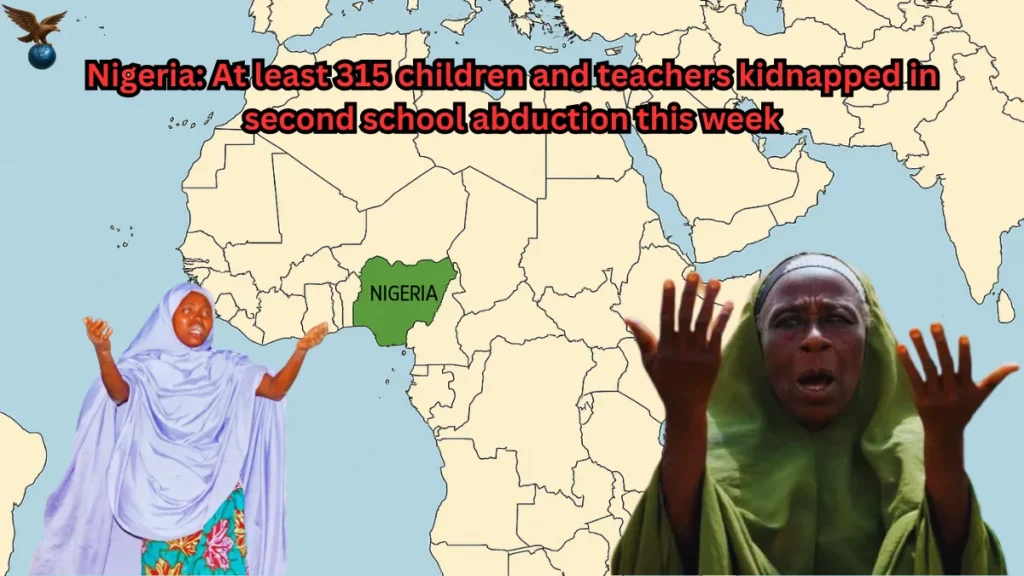
Nigeria Children Kidnapped: In a disturbing escalation of violence in Nigeria, armed militants stormed St. Mary’s Boarding School in Papiri village, Niger State, on the night of November 20, 2025. Around 2 a.m., a group of heavily armed assailants broke into the school, abducting 303 students and 12 teachers. Most of the victims were Christians, highlighting the growing religious tension in the country. Local authorities report that Nigeria has witnessed the killings of more than 7,000 Christians this year alone, a figure that has drawn international attention and condemnation. Former U.S. President Donald Trump has publicly warned that if necessary, the United States would intervene militarily to protect Christians from systematic attacks, promising armed retaliation against perpetrators.
This shocking incident raises urgent questions: Why is violence against Christians escalating in Nigeria? Who is behind these attacks, what are their objectives, and will international intervention, such as from the U.S., actually help curb the crisis?
The Staggering Reality of Nigeria’s School Kidnappings
According to local police reports, there were 629 individuals present at St. Mary’s Boarding School when the attack occurred. The abducted 315 included 303 students and 12 teachers, most of whom were Christians. Security forces, including the military and police, have launched search operations in the surrounding forests, but the kidnappers’ whereabouts remain unknown.
St. Mary’s operated without government approval, accommodating students aged 12 to 17. This is reminiscent of the infamous 2014 Chibok abduction in northern Nigeria, when 276 schoolgirls—primarily Christian—were kidnapped. Some of those girls managed to escape, others were rescued, but nearly 90 remain missing to this day. These incidents underscore a long and troubling history of targeted violence, kidnappings, and killings against Christians in Nigeria.
Historical Context: How Christian-Muslim Tensions Escalated
Nigeria gained independence from Britain in 1960. At that time, the population was roughly divided: 50% Muslim, 40% Christian, and the remainder comprised indigenous African ethnic groups. Northern Nigeria has traditionally been predominantly Muslim, with communities such as the Hausa and Fulani following Sharia law, mostly as farmers, traders, and herders.
Southern Nigeria, including regions dominated by the Yoruba and Igbo ethnic groups, saw significant Christian missionary influence in the 19th century, resulting in widespread Christian conversion. Tensions between Muslims and Christians in Nigeria date back decades. In 1953, violent clashes erupted in Kano, a predominantly Muslim city, as Christian traders began establishing a stronger presence. Fear of Christian expansion fueled riots, resulting in hundreds of deaths.
Following independence, sporadic Christian-Muslim conflicts persisted. On May 30, 1967, Colonel Odumegwu led the Igbo Christians in declaring the independent “Biafra Republic,” triggering a civil war that lasted until January 1970. The war, coupled with famine and disease, claimed approximately three million lives. Following Biafra’s defeat, Nigeria was reintegrated, but political instability continued. Between 1966 and 1998, the nation experienced six coups, each installing military governments.
During the 1980s, extremist Muslim leaders, including Muhammad Marwa in Kano, initiated violent campaigns against Christians and government institutions, escalating the death toll further. One notable incident occurred in 1982 in Kafanchan, where clashes between Christian and Muslim students led to widespread violence, killing thousands from both communities.
The early 2000s saw the rise of Boko Haram, a jihadist group whose name literally means “Western education is forbidden.” Boko Haram systematically targeted Christian communities, churches, and schools. Their attacks became increasingly brutal after 2009, including mass kidnappings such as the 2014 Chibok abduction. In 2016, a more radical splinter group, the Islamic State West Africa Province (ISWAP), emerged, intensifying attacks against Christians.
Reports indicate that armed Muslim herder groups in the Middle Belt, along with Boko Haram and ISWAP militants, have killed over 50,000 Christians since 2009. While other civilians, including Muslims, have also been victims, Christians have been disproportionately targeted in these attacks.
The Current Religious Landscape in Nigeria
Nigeria’s population now stands at approximately 230 million, with Muslims making up 56% and Christians around 43%. The northern region comprises 19 states with a Muslim majority, while the south has 17 predominantly Christian states. Several central states feature a mixed population. According to the International Society for Civil Liberties and the Rule of Law, more than 7,000 Christians have been killed in the first 220 days of 2025, primarily in the Middle Belt and northern regions.
Causes of the Ongoing Christian-Muslim Conflict
Nigeria’s religious violence is multifaceted, with different regions presenting distinct challenges:
- Middle Belt Violence: Fulani militant herders have carried out numerous attacks for control of land. Over half of Christian deaths occur in the Middle Belt states of Benue, Plateau, and Kaduna. Increasing desertification in the north has driven Fulani herders southward, leading to violent clashes over farmland. Nighttime raids on Christian villages, church burnings, abductions of women, and killings of men have become tragically common.
- Northeastern Jihadist Attacks: Boko Haram and ISWAP are highly active in northeastern Nigeria. They have seized control of multiple localities and issued ultimatums forcing Christians to leave. Both groups vehemently oppose Christian missionary work and education, with schools and churches regularly targeted. Reports indicate that over 20% of Christian deaths this year occurred in Borno and Yobe states.
- Northwestern Banditry: In states such as Kwara, Kogi, and Edo, looting, kidnappings, and violent raids on Christians are frequently conducted by armed gangs like Ansaru and Lakurawa. These groups sometimes collaborate with jihadist factions.
Southern states, predominantly Christian, experience less religiously motivated violence. Here, crimes tend to be related to theft and local disputes rather than targeted attacks.
The overarching cause of Christian deaths in Nigeria is religious conflict, compounded by government failure, military corruption, and poverty, which make it difficult to control armed groups.
Are the Attacks One-Sided?
While Christians are the primary victims, reports indicate that more than 3,000 Muslims have also been killed this year due to attacks by Boko Haram, Al-Qaeda-affiliated groups, and ISIS-linked organizations. In some cases, local Christian farmers in Plateau and Kaduna states have formed vigilante groups in retaliation, occasionally resulting in the deaths of Muslim assailants.
According to Global reports, most victims are Christians, though government data suggest that from January 2020 onward, over 20,000 people have been killed in Nigeria without religious identification. Some attacks deliberately targeting Christians have killed 317, while attacks on Muslims have claimed 417 lives.
Nanamdi Obasi, of the International Crisis Group, explains that Boko Haram has targeted both Christians and Muslims in the northeast, while bandits in the northwest primarily target Muslims. Christian farmers are particularly vulnerable in the Middle Belt.
The Nigerian government disputes claims of systematic Christian targeting, with Foreign Ministry spokesperson Kimbi Emomotimi asserting that attacks by Boko Haram-affiliated groups affect all religions, and overemphasizing Christian victimization risks worsening national tensions.
Government Response and Military Action
The Nigerian government, led by President Bola Ahmed Tinubu, has undertaken significant measures to combat terrorism and protect civilians. Security forces have killed over 13,000 militants and rescued approximately 10,000 hostages in the past year. Covert operations have seized more than 4,000 AK-47 rifles and other weapons. Additionally, the government has deployed troops to protect churches, schools, and markets, and provided about $2.3 million in aid to affected communities.
President Tinubu reaffirmed on November 1, 2025, that Nigeria is a democratic nation committed to safeguarding religious freedom. He emphasized ongoing dialogue with community leaders to address the crisis.
U.S. Involvement and Potential Military Intervention
The United States has raised the issue of religious freedom in Nigeria. On October 31, 2025, former President Donald Trump stated that Christianity in Nigeria faces existential threats from extremist Islamist groups, including Boko Haram, which have killed thousands of Christians. The U.S. designated Nigeria as a “Country of Particular Concern” (CPC), signaling severe and ongoing violations of religious freedom.
Trump warned that if Nigeria fails to protect Christians, the U.S. would cut all aid. Approximately 21% of Nigeria’s healthcare budget comes from U.S. assistance. On November 3, he suggested the possibility of U.S. military strikes if the situation worsened. Defense Secretary Pete Hegseth echoed readiness to act, saying U.S. forces are prepared to support Nigeria in combating terrorists.
Subsequent discussions between U.S. and Nigerian security officials emphasized joint efforts to weaken militant groups. Under the International Religious Freedom Act of 1998, the U.S. could impose sanctions, visa restrictions, and trade limitations in response to continued religious persecution. Notably, Nigeria and the U.S. had bilateral trade totaling $13 billion in 2024, making any sanctions potentially impactful.
Why the World Should Care
The kidnapping of Nigeria children is not just a local tragedy—it highlights a broader humanitarian crisis rooted in ethnic, religious, and political tensions. With millions affected and violence continuing unabated, the international community faces growing pressure to respond.
The targeting of schools and children represents a particularly heinous strategy by extremist groups to disrupt education and instill fear in communities. Global advocacy groups have called for stronger intervention measures, including diplomatic pressure, intelligence sharing, and targeted humanitarian assistance.
Also read: Clash Between Trump and Ramaphosa Intensifies as G20 Leadership Dispute Breaks Tradition
Lessons from History and the Way Forward
Nigeria’s troubled history shows that religious violence is cyclical, with root causes in ethnic tension, land disputes, and government neglect. Effective long-term solutions must address these underlying issues while protecting vulnerable communities. Strategies could include:
- Strengthening local law enforcement and judicial systems to prosecute perpetrators.
- Encouraging interfaith dialogue to reduce polarization.
- Providing economic incentives and support to mitigate conflicts over land and resources.
- Enhancing international cooperation to tackle terrorism and organized crime.
Failing to act could result in further kidnappings, killings, and destabilization. The international community, regional governments, and Nigerian authorities face urgent responsibility to protect citizens, particularly schoolchildren, from violence.
Also read: Ethiopia Confirms First Outbreak of Marburg Virus: Health Authorities on High Alert
Conclusion: Nigeria Children Kidnapped
The recent attack at St. Mary’s Boarding School is a stark reminder of the escalating crisis in Nigeria, where thousands of Christians have been killed, and hundreds of children abducted in a single year. The Nigeria children kidnapped case underscores the ongoing threat posed by extremist groups like Boko Haram, ISWAP, and armed Fulani militants. Historical religious tensions, political instability, and systemic failure have created conditions where such violence thrives.
With the Nigerian government taking steps to combat terrorism and the United States signaling possible intervention, the world watches closely. Resolving this crisis requires both immediate action to safeguard lives and long-term strategies to address the deep-rooted causes of religious conflict. The stakes could not be higher: the safety of Nigeria’s children, the survival of its Christian communities, and the country’s stability hang in the balance.